
The Design Advantage of StormSlab®’s Spigot and Vent Location
Modern developments are facing growing regulatory pressure to incorporate on-site stormwater detention and retention systems, especially on compact residential and mixed-use sites. As architects and engineers look to in-slab solutions to maximize land use, the true performance of a stormwater tank depends not just on its gross (total internal) volume, but on its actual usable volume—the amount of water that can be effectively stored, accessed, and discharged.
Engineers are increasingly finding that theoretical retention calculations fail in the real world due to outlet placement. APD’s StormSlab® system is engineered specifically to optimize usable volume through precision placement of its spigot (outlet) and vent, providing one of the most efficient storage solutions available for concrete-slab integration. By minimizing dead volume, eliminating air locks, and relocating all connections outside the building envelope, StormSlab® delivers verifiable storage performance with uncompromised constructability.
In many in-slab tank systems, there is a significant difference between the stated gross volume and the amount of water that can actually be used. Two design issues are responsible:
When outlets sit above the tank floor or require internal pipework, the base of the tank traps water that cannot drain—reducing usable capacity.
Poor venting can trap air in the tank, preventing it from filling to the top and reducing total storage available during storm events.
These inefficiencies directly affect compliance, as councils require proof that the system can deliver its specified storage volume—not merely its theoretical capacity.
| Feature | Standard “High-Spigot” Tank | StormSlab® Optimized Design | Impact on Compliance |
| Gross Volume | 350 Litres | 350 Litres | N/A (Theoretical max) |
| Outlet Position | 50mm – 80mm above floor | At Tank Invert (0mm) | High outlets trap water (“Dead Volume”). |
| Venting | Side/End wall (air trap risk) | Top-mounted (full displacement) | Poor venting creates air locks, preventing full capacity. |
| Dead Volume Loss | ~18L – 53L (5-15% loss) | < 1.75L (< 0.5% loss) | Critical: Reduces effective detention capacity. |
| Net Usable Volume | ~297L – 332L | ~348L+ | Standard tanks may fail hydraulic modelling requirements. |
StormSlab® was purpose-designed to eliminate these hidden losses by addressing both root causes:
The outlet spigot is positioned at the tank invert, allowing the system to drain water down to the lowest possible level.
This design ensures StormSlab®’s published figures reflect true usable volume, not inflated gross capacity.
StormSlab® incorporates top-mounted venting to allow full displacement of air as the tank fills.
This avoids partial filling, ensures maximum storage performance, and supports full compliance with council retention/detention requirements.
Together, these features allow StormSlab® to deliver a net usable capacity extremely close to its total internal volume – an essential advantage where space is limited and every litre counts.
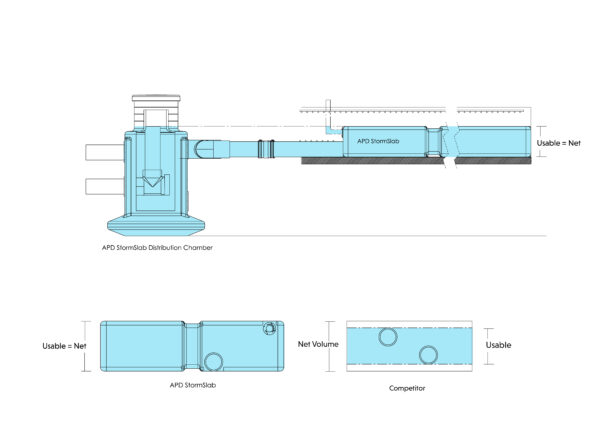
A major challenge with in-slab tanks is integrating outlet connections without compromising slab integrity. Many systems require pipe penetrations and seals within the slab—elements that are difficult to inspect, rely on long-term seal performance, and introduce potential leak risks.
StormSlab® avoids this risk entirely.
Each spigot is fully welded and pressure-tested at APD’s facility, ensuring 100% water-tight performance before delivery.
The welded spigot is designed to penetrate the edge of the slab, not pass through it.
All critical joints – including flexible connections to the PVC manifold – are installed outside the building envelope.
This approach provides two critical advantages:
This edge-penetration design is one of StormSlab®’s defining engineering strengths.
StormSlab seamlessly integrates into common stormwater configurations, offering flexibility for both standalone and combined storage systems.
Multiple tanks can be connected to separate distribution chambers—one for reuse, one for controlled discharge.
A single distribution chamber can manage:
All connections are run externally, allowing the distribution chamber to be positioned up to 20 metres from the tanks, enabling optimal site layout and avoiding clashes with services or structural elements.
StormSlab®’s modular design supports a wide range of construction scenarios:
This makes StormSlab one of the most flexible and compliant in-slab stormwater systems available in New Zealand.
Councils assess stormwater performance on actual functional storage, not theoretical tank size.
A system that loses 5–15% of its volume to dead zones or air locks risks:
StormSlab®’s precision-engineered spigot and venting system ensures advertised volumes match real-world performance—giving engineers confidence in their designs and councils confidence in approvals.
StormSlab® is more than an in-slab tank—it’s a complete engineering solution designed for reliability, constructability, and verifiable storage performance.
By maximising usable volume, eliminating in-slab risks, and offering unmatched installation flexibility, StormSlab® sets a new benchmark for stormwater detention and retention in modern construction.
It delivers the three outcomes that matter most:
Subscribe for regular updates, your email address is required for subscription.